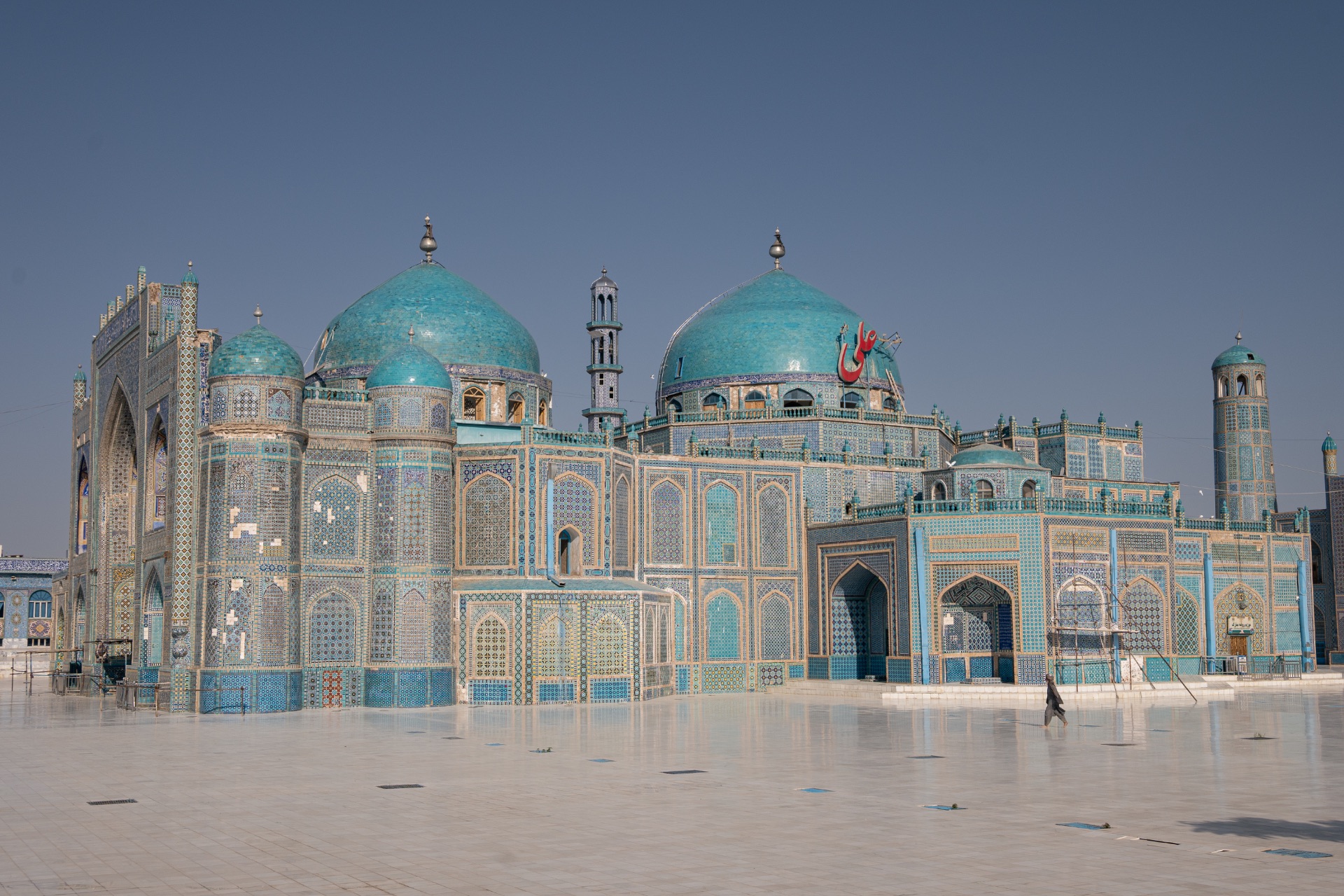
At the heart of Mazar-i-Sharif, turquoise domes rise above a courtyard filled with white pigeons. This is the Shrine of Hazrat Ali, often called the Blue Mosque — a place that gives the city its name and remains central to its spiritual life. From a distance, its walls seem to be made entirely of blue. Come closer and they reveal thousands of individual tiles, patterns and inscriptions. Yet the shrine is more than its architecture. People come here to pray, to meet, to bring their children and to spend time in a place that has mattered to generations before them.
History & Details
According to a local tradition, Hazrat Ali — cousin and son-in-law of the Prophet Muhammad — is buried here. The tradition is not shared throughout the Muslim world; many hold that his tomb is in Najaf, Iraq. In Mazar-i-Sharif, however, the shrine has long been a place of profound devotion, and the city grew around it.
A sanctuary stood here centuries before the building seen today. The present shrine took shape under the Timurid ruler Sultan Husayn Bayqara in the late fifteenth century. Its domes, portals and intricate tilework reflect an artistic world that also flourished in nearby Balkh and Herat. Later generations added to and cared for the complex, leaving a building shaped by more than one period of Afghan history.
The shrine remains closely connected to the life of the city. Its courtyard is a gathering place as well as a sacred one, where the grandeur of the architecture meets ordinary daily rhythms.
Gallery
Visitor Experience
“The first impression is colour: blue against the sky, turquoise across the domes, small pieces of ceramic catching the sun. Then the scale changes. At your feet, pigeons move through the courtyard. A family pauses together. Someone crosses the open space while another person sits quietly near the walls. Take time to walk around the outside of the shrine. From one angle the domes define the whole skyline; from another, a single worn tile or a fragment of calligraphy draws your attention. The people who come here are part of its story, so we visit with the care due to a living place of worship. The Shrine of Hazrat Ali stays with you for its beauty. What gives that beauty meaning is the life continuing around it.”
Trips That Visit Shrine of Hazrat Ali

Don't see a trip that fits? We can build one entirely around the places you want to see.
Plan a Custom Visit